---
title: The Gut-Brain Connection and Its Impact on Your Health
description: The gut-brain connection plays a bigger role in your mood, stress, and overall well-being than you might think. Learn which habits help support this vital link.
image: https://blog.silverandfit.com/hubfs/SF%20Blog/Article%20Images/Blog%20218%20-%20Gut-Brain%20Connection/Lifestyle_gut-brain%20connection_feature.png
---
[LOG IN](https://www.silverandfit.com/identity/login) [Check Eligibility](https://www.silverandfit.com/identity/registration)
- [HOMEPAGE](https://www.silverandfit.com/)
- [WELL-BEING CLUB](https://www.silverandfit.com/well-being-club)
- [FITNESS CENTERS](https://www.silverandfit.com/search)
- FIT AT HOME
- [Workouts](https://www.silverandfit.com/workouts)
- [Home Kits](https://www.silverandfit.com/home-kits)
- [PARTICIPATING HEALTH PLANS](https://www.silverandfit.com/health-plans)
- [HOW IT WORKS](https://www.silverandfit.com/how-it-works)
- [FAQ](https://www.silverandfit.com/faq)
- [BLOG](https://blog.silverandfit.com/)
### Topics
- Select a Topic
- [All](https://blog.silverandfit.com)
- [Nutrition](https://blog.silverandfit.com/tag/nutrition)
- [Healthy Aging](https://blog.silverandfit.com/tag/healthy-aging)
- [Fitness](https://blog.silverandfit.com/tag/fitness)
- [Lifestyle](https://blog.silverandfit.com/tag/lifestyle)
### Get the latest tips in your inbox
SUBSCRIBE

By providing your email you consent to receiving updates to the Silver&Fit blog by email. Silver&Fit does not share or sell your email to any third-parties. You may unsubscribe at any time by clicking the link at the bottom of the email.
[Lifestyle](https://blog.silverandfit.com/tag/lifestyle)
# The Gut-Brain Connection and Its Impact on Your Health

By [The Silver&Fit® Team at American Specialty Health](https://blog.silverandfit.com/author/american-specialty-health) on August 31, 2026
[](http://www.facebook.com/sharer/sharer.php?u=https://blog.silverandfit.com/tag/lifestyle/gut-brain-connection) [](https://twitter.com/home?status=The%20Gut-Brain%20Connection%20and%20Its%20Impact%20on%20Your%20Health+https://blog.silverandfit.com/tag/lifestyle/gut-brain-connection) [](http://www.linkedin.com/shareArticle?mini=true&url=https://blog.silverandfit.com/tag/lifestyle/gut-brain-connection) [](mailto:?body=https://blog.silverandfit.com/tag/lifestyle/gut-brain-connection)

The gut-brain connection plays a bigger role in your mood, stress, and overall well-being than you might think. Learn which habits help support this vital link.
When you think about your brain, you likely picture the organ that’s in charge of decision-making, rational thought, and running a lot of your body’s many functions. It’s also the seat of your emotions. Your gut, on the other hand, is mainly in charge of digestion.
This is all essentially true. But what you may not realize is that your brain and your gut actually *talk* to each other—all the time. They’re connected. So, your gut does more than just digest food. Sometimes “feelings in your gut” are actually due to signals sent by your brain—and vice-versa.
For example, maybe you’ve felt “butterflies” in your stomach or felt so nervous that your stomach hurt. Maybe you’ve suddenly had to use the bathroom before a presentation. These moments are more than just nerves. It’s your gut picking up stress signals from your brain and responding to them with digestive upset. Likewise, your gut can send signals to the brain. Let’s take a deeper dive into how this 2-way connection works.
**The “second brain” in your gut**
There is a collection of nerve cells that line your gastrointestinal tract called the enteric nervous system—or ENS. Scientists call the ENS your “second brain.” It is not capable of independent thought like your other brain is. Its main job is to control digestion by breaking down food and helping you absorb nutrients from it. But this “second brain” in your gut also sends and receives messages to and from your brain.
To break it down further, strong emotions—such as anger, anxiety, fear, and excitement—can cause symptoms in the stomach and intestines. That’s because your brain sends these emotional distress signals to your gut’s ENS. But here’s how this communication can go both ways. Say, for example, you develop an irritated stomach from eating spoiled food. Your gut sends signals to the brain, triggering stress, anxiety, or other mood changes in response to your upset stomach.
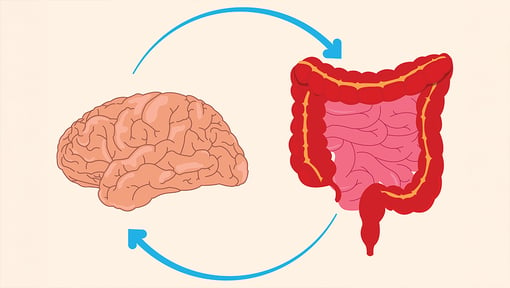
**A closer look at how the gut-brain connection works**
It’s worth pointing out that these gut-related feelings are *not* just in your head. That feeling of nausea before giving a presentation feels real because it is. Your stress and other emotions are real, too. And they can manifest in real, physical ways, causing pain in your gut or other bowel symptoms.
But how does this powerful gut-brain interaction work, exactly? Take those butterflies in your stomach, for example. When you experience a strong emotion in your brain, your body’s “fight or flight” system kicks in. Adrenaline and other stress hormones are released into your bloodstream. Your body then prioritizes the body parts that can help you run or fight, which means it knows to divert blood away from your gut and toward your muscles.
As a result, you have less blood flow and energy in your digestive system. This causes your stomach and intestines, which normally contract steadily, to contract irregularly. These off-kilter GI-tract contractions can feel like the fluttering of butterfly wings.
Now you know the role that emotion and stress can play between your brain and your gut, let’s talk about some of the habits that can help steady your mood, ease stress, aid digestion, and improve your gut-brain connection and overall health.
**How to support a healthy gut-brain connection**
Supporting the health of both your gut *and* your brain is key to maintaining a healthy, smooth-functioning connection between them.
When it comes to gut health, keep in mind that the lining of your gut can be irritated by many things: infection, stress, processed foods, alcohol, allergies, or conditions such as [irritable bowel syndrome](https://www.niddk.nih.gov/health-information/digestive-diseases/irritable-bowel-syndrome/definition-facts/). Likewise, your brain health can suffer from ongoing stress, anxiety, loneliness, or depression. And, as mentioned before, if your gut is struggling, your mental health can also suffer—and the other way around.
Take the steps below to maintain better support of *both* your gut and your brain health. It may help keep your gut-brain connection humming along smoothly.
- Keep your gut flora in balance. The lining of your digestive tract has microorganisms that can affect not only your gut health but also your mood and behavior. Most of them are bacteria. And you need to multiply them to support a healthy microbiome. You can do this by [adding probiotics to your diet](https://blog.silverandfit.com/tag/nutrition/probiotics-and-prebiotics), such as yogurt, kombucha, and certain cheeses. You can also consider taking probiotic supplements—but only do so on the advice of your doctor. You should also feed the good microbes in your gut by eating prebiotic-rich foods such as apples, bananas, oats, carrots, and sweet potatoes.
- Eat a diet with fiber. Fiber helps clean your digestive tract. To improve gut health, add one fiber-rich food to your daily diet, such as beans, oats, or berries. Make sure to drink plenty of water with it, too. Just make sure you add fiber to your diet gradually, not all at once.
- Eat anti-inflammatory foods. Reducing sugar, additives, and cholesterol is good for your gut microbes. Try to avoid [ultraprocessed foods](https://blog.silverandfit.com/tag/nutrition/ultra-processed-foods) and eat a whole-food, plant-rich diet instead. Also, limit alcohol because it is an inflammatory substance.
- Manage your stress and anxiety. You can lower both of these with deep breathing, mindfulness meditation, or guided imagery. Staying [socially connected](https://blog.silverandfit.com/tag/healthy-aging/social-connections) can also help lower your stress and anxiety, which can indirectly help with gut symptoms.
- Sleep well and exercise regularly. Both of these good-for-you habits not only help ease stress, they also help improve digestion (gut health).

**When to talk with your doctor**
It’s completely normal for your gut to react to anxiety or stress, and—vice-versa—for your brain to react to digestive upset. That’s not necessarily a problem, *unless* it becomes chronic and/or severe, and the self-care measures above don’t resolve the problem. But how can you tell if you should talk with your doctor? Do so if you have chronic and/or severe:
- Bloating
- Cramping
- Constipation or diarrhea
- Reflux
- Heartburn
If these symptoms don’t get better, or become worse, be sure to schedule an appointment with your doctor. They can help you come up with a plan to [reduce your stress](https://blog.silverandfit.com/tag/lifestyle/stress-relief) and manage symptoms that may be affecting your gut health.
****
**Final thoughts**
A healthy lifestyle supports your overall health and well-being—but also the health of your important gut-brain connection. So, try to keep your stress under control and your diet healthy and clean. And the next time you’re so nervous that you are hit with a wave of nausea, stay present and remind yourself that your brain is simply having a conversation with your gut. And the nausea in your gut is telling your brain to take some slow, deep breaths to calm your nerves. How cool is that?
Not a Silver&Fit® member? Learn more about everything the program has to offer, including more helpful healthy living tips like this, [here on our website](https://www.silverandfit.com/).
*This information is not intended to take the place of regular medical care or advice. Please check with your doctor before using this information or beginning any self-care program. Images used for this article do not depict any members of the Silver&Fit Program.*
**References**
Ataei, P., Kalantari, H., Bodnar, T. S., & Turner, R. J. (2026). The gut–brain connection: Microbes’ influence on mental health and psychological disorders. Frontiers in Microbiomes, 4, Article 1701608. [https://doi.org/10.3389/frmbi.2025.1701608](https://doi.org/10.3389/frmbi.2025.1701608)
Bonaz, B., Bazin, T., & Pellissier, S. (2018). The vagus nerve at the interface of the microbiota-gut-brain axis. Frontiers in Neuroscience, 12, 49. [https://doi.org/10.3389/fnins.2018.00049](https://doi.org/10.3389/fnins.2018.00049)
Centers for Disease Control and Prevention. (2024, May 15). Fiber: The carb that helps you manage diabetes. [https://www.cdc.gov/diabetes/healthy-eating/fiber-helps-diabetes.html](https://www.cdc.gov/diabetes/healthy-eating/fiber-helps-diabetes.html)
Cleveland Clinic. (2023, September 20). The gut-brain connection.
[https://my.clevelandclinic.org/health/body/the-gut-brain-connection](https://my.clevelandclinic.org/health/body/the-gut-brain-connection)
Cleveland Clinic. (2024, October 2). 20 ways to relieve stress. Cleveland Clinic Health Essentials. [https://health.clevelandclinic.org/how-to-relieve-stress](https://health.clevelandclinic.org/how-to-relieve-stress)
Gingrasso, A. (2025, April 23). Good bacteria for your gut. Mayo Clinic Health System. [https://www.mayoclinichealthsystem.org/hometown-health/speaking-of-health/good-bacteria-for-your-gut](https://www.mayoclinichealthsystem.org/hometown-health/speaking-of-health/good-bacteria-for-your-gut)
Harvard Medical School. (2023, July 18). The gut-brain connection. Harvard Health Publishing. [https://www.health.harvard.edu/diseases-and-conditions/the-gut-brain-connection](https://www.health.harvard.edu/diseases-and-conditions/the-gut-brain-connection)
Harvard T. H. Chan School of Public Health. (n.d.). The microbiome. The Nutrition Source. [https://nutritionsource.hsph.harvard.edu/microbiome/](https://nutritionsource.hsph.harvard.edu/microbiome/)
Harvard Health Publishing. (2022, November 14). Probiotics and prebiotics: What’s really important. [https://www.health.harvard.edu/nutrition/are-you-getting-essential-nutrients-from-your-diet](https://www.health.harvard.edu/nutrition/are-you-getting-essential-nutrients-from-your-diet)
Johns Hopkins Medicine. (n.d.). The brain-gut connection. [https://www.hopkinsmedicine.org/health/wellness-and-prevention/the-brain-gut-connection](https://www.hopkinsmedicine.org/health/wellness-and-prevention/the-brain-gut-connection)
Madison, A., & Kiecolt-Glaser, J. K. (2019). Stress, depression, diet, and the gut microbiota: Human–bacteria interactions at the core of psychoneuroimmunology and nutrition. Current Opinion in Behavioral Sciences, 28, 105–110. [https://doi.org/10.1016/j.cobeha.2019.01.011](https://doi.org/10.1016/j.cobeha.2019.01.011)
National Institute of Diabetes and Digestive and Kidney Diseases. (2017, November). Definition & facts for irritable bowel syndrome. U.S. Department of Health and Human Services, National Institutes of Health. [https://www.niddk.nih.gov/health-information/digestive-diseases/irritable-bowel-syndrome/definition-facts/](https://www.niddk.nih.gov/health-information/digestive-diseases/irritable-bowel-syndrome/definition-facts/)
Salamon, M. (2026, February 18). How the gut-brain connection influences mood. Harvard Health Publishing, Harvard Medical School. [https://www.health.harvard.edu/digestive-health/how-the-gut-brain-connection-influences-mood](https://www.health.harvard.edu/digestive-health/how-the-gut-brain-connection-influences-mood)
Scienceinsights.org. (2026, May 2). Butterflies in your stomach: What’s really happening. [https://scienceinsights.org/butterflies-in-your-stomach-whats-really-happening/](https://scienceinsights.org/butterflies-in-your-stomach-whats-really-happening/)
This article was written by Stephanie Ruiz, edited by Gail Olson, CMT, HHP, and clinically reviewed by Elizabeth Thompson, MPH, RDN, on June 5, 2026.
[Return to Homepage](https://blog.silverandfit.com/)
## About the Author

### The Silver&Fit® Team at American Specialty Health
The award-winning Silver&Fit® Blog is brought to life by a seasoned team of professionals at American Specialty Health (ASH), an organization with nearly 2 decades of experience in senior wellness programming. The Silver&Fit® blog writers, editors, clinicians, designers, and marketing specialists are dedicated to delivering engaging, informative wellness content. Every article is carefully researched and clinically reviewed for accuracy. Our goal? Content that supports healthy aging through trusted, research-based insights on fitness, nutrition, stress management, and more, tailored specifically for older adults seeking to live more vibrant, active, and healthy lives.
#### Recommended Articles
[](https://blog.silverandfit.com/tag/lifestyle/solitude)
##### [Why Solitude Is as Important to Your Well-Being as Socializing](https://blog.silverandfit.com/tag/lifestyle/solitude)
\- September 21, 2026
[](https://blog.silverandfit.com/tag/lifestyle/healthy-relationships)
##### [How to Keep Relationships Healthy As You Age](https://blog.silverandfit.com/tag/lifestyle/healthy-relationships)
\- June 8, 2026
### Popular Posts
### Get the latest tips from Silver&Fit in your inbox.
### Recent Post
### Recent Posts
[Training for Pickleball: Strength, Balance, and Injury Prevention](https://blog.silverandfit.com/tag/fitness/pickleball-training)
\- 31 August, 2026
[Why Solitude Is as Important to Your Well-Being as Socializing](https://blog.silverandfit.com/tag/lifestyle/solitude)
\- 31 August, 2026
[Nature RX: How Green Spaces Protect Your Brain Health](https://blog.silverandfit.com/tag/healthy-aging/green-spaces)
\- 31 August, 2026
[Fall Morning Muffins for a Cozy Start to Your Day](https://blog.silverandfit.com/tag/nutrition/fall-muffins)
\- 31 August, 2026
[The Gut-Brain Connection and Its Impact on Your Health](https://blog.silverandfit.com/tag/lifestyle/gut-brain-connection)
\- 31 August, 2026
Brought To You By

### Silver&Fit
The Silver&Fit® program provides eligible members with a fitness center membership and options to stay Fit at Home.
-
-
-
-
-
### Topics
- [Nutrition (57)](https://blog.silverandfit.com/tag/nutrition)
- [Healthy Aging (55)](https://blog.silverandfit.com/tag/healthy-aging)
- [Fitness (53)](https://blog.silverandfit.com/tag/fitness)
- [Lifestyle (52)](https://blog.silverandfit.com/tag/lifestyle)
### We've been expertly designing senior fitness programs for nearly 20 years. Now, we're excited to share the health in our blog, free and available to the public. Interested? Get the latest fitness, healthy aging, lifestyle, and nutrition tips in your inbox!
SUBSCRIBE
[Facebookfacebook](https://www.facebook.com/SilverandFit) [Instagraminstagram](https://www.instagram.com/silverandfit/?hl=en) [youtube](https://www.youtube.com/user/silverandfit) [Pinterestpinterest](https://pinterest.com/silverandfit) [LinkedInlinkedin](https://www.linkedin.com/company/american-specialty-health)
- Useful Links
- [About Us](https://www.silverandfit.com/About)
- [Terms & Conditions](https://www.silverandfit.com/TermsAndConditions)
- [Privacy Statement](https://www.silverandfit.com/Privacy)
- [FAQ](https://www.silverandfit.com/FAQ)
- [Site Map](https://www.silverandfit.com/sitemap)
## Connect
[Contact Us](https://www.silverandfit.com/contactus)
## Language Assistance
The following PDF files will open in a new window. You must have [Adobe ReaderOpens an external site in a new tab](https://acrobat.adobe.com/us/en/acrobat/pdf-reader.html) installed to view the files.
- [English](https://blog.silverandfit.com/hubfs/SF%20Linked%20Files/M950-1031A%20Language%20Support_tcm26-161058.pdf)
- [Español](https://blog.silverandfit.com/hubfs/SF%20Linked%20Files/M950-1031A%20Language%20Support_tcm26-161058.pdf)
- [繁體中文](https://blog.silverandfit.com/hubfs/SF%20Linked%20Files/M950-1031A%20Language%20Support_tcm26-161058.pdf)
- [Tagalog](https://blog.silverandfit.com/hubfs/SF%20Linked%20Files/M950-1031A%20Language%20Support_tcm26-161058.pdf)
- [Tiếng Việt](https://blog.silverandfit.com/hubfs/SF%20Linked%20Files/M950-1031A%20Language%20Support_tcm26-161058.pdf)
- [العربية](https://blog.silverandfit.com/hubfs/SF%20Linked%20Files/M950-1031A%20Language%20Support_tcm26-161058.pdf)
- [Français](https://blog.silverandfit.com/hubfs/SF%20Linked%20Files/M950-1031A%20Language%20Support_tcm26-161058.pdf)
- [한국어](https://blog.silverandfit.com/hubfs/SF%20Linked%20Files/M950-1031A%20Language%20Support_tcm26-161058.pdf)
- [Русский](https://blog.silverandfit.com/hubfs/SF%20Linked%20Files/M950-1031A%20Language%20Support_tcm26-161058.pdf)
- [Deutsch](https://blog.silverandfit.com/hubfs/SF%20Linked%20Files/M950-1031A%20Language%20Support_tcm26-161058.pdf)
- [Kreyòl Ayisyen](https://blog.silverandfit.com/hubfs/SF%20Linked%20Files/M950-1031A%20Language%20Support_tcm26-161058.pdf)
- [हिंदी](https://blog.silverandfit.com/hubfs/SF%20Linked%20Files/M950-1031A%20Language%20Support_tcm26-161058.pdf)
- [Português](https://blog.silverandfit.com/hubfs/SF%20Linked%20Files/M950-1031A%20Language%20Support_tcm26-161058.pdf)
- [Italiano](https://blog.silverandfit.com/hubfs/SF%20Linked%20Files/M950-1031A%20Language%20Support_tcm26-161058.pdf)
- [Polski](https://blog.silverandfit.com/hubfs/SF%20Linked%20Files/M950-1031A%20Language%20Support_tcm26-161058.pdf)
- [اُردُو](https://blog.silverandfit.com/hubfs/SF%20Linked%20Files/M950-1031A%20Language%20Support_tcm26-161058.pdf)
- [אידיש](https://blog.silverandfit.com/hubfs/SF%20Linked%20Files/M950-1031A%20Language%20Support_tcm26-161058.pdf)
- [বাংলা](https://blog.silverandfit.com/hubfs/SF%20Linked%20Files/M950-1031A%20Language%20Support_tcm26-161058.pdf)
- [Ελληνικά](https://blog.silverandfit.com/hubfs/SF%20Linked%20Files/M950-1031A%20Language%20Support_tcm26-161058.pdf)
- [Shqiptar](https://blog.silverandfit.com/hubfs/SF%20Linked%20Files/M950-1031A%20Language%20Support_tcm26-161058.pdf)
Newtab\_Icon Clicking on these links will take you away from Silverandfit.com. Silver&Fit is not responsible for any content or the privacy practices of external websites.
The Silver&Fit program is a product of American Specialty Health Fitness, Inc. (ASH Fitness), a subsidiary of American Specialty Health Incorporated. ASH Fitness complies with applicable federal civil rights laws and does not discriminate on the basis of race, color, national origin, age, disability, or sex.
© 2020-2025 American Specialty Health Incorporated (ASH). All Rights Reserved.
Last Updated 11/2025