
Transform your heart health and fitness in no time with interval walking! Discover 2 easy, research-backed routines that you can start today.
Walking is a go-to exercise for many. It’s a simple way to boost your fitness that comes with tons of health benefits. It helps endurance, improves balance, and reduces stress, to name a few.
Interval training is a fitness method that involves adding bursts of higher-intensity exercise to your workout. It gets results in less time. And it’s a boon for heart health. When you apply interval training to walking, you get interval walking—a simple and efficient workout that nearly anyone can do.
What is interval walking?
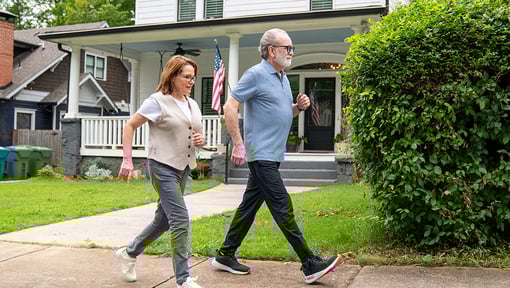
Interval walking is a workout that alternates between slow and fast walking. It adds the benefits of interval training to your walking workout.
During interval training, you alternate between intense effort and recovery. Your heart works hard and then rests. That helps your body use oxygen more efficiently, strengthening your heart and lungs. Any type of interval training, including interval walking, is a great workout for heart health.
Interval walking is also a time-saver. It’s more work to bring your heart rate up than to keep it steady. So, by alternating between higher- and lower-intensity, you’re bringing your heart rate up again and again. You’re working harder in the same amount of time. That also burns more calories. And it keeps your walk interesting—which might help you stick with your workout.
How to gauge your intensity
You can think of interval walking as 2 phases: working and recovery. Your working phase will be moderate to high intensity. Your recovery phase will be low to moderate intensity.
Intensity is based on personal effort, not a fixed pace. You decide the right intensity for you. That makes interval walking a safe workout for older adults. And you can adjust the intensity as you build strength and endurance. So, no matter where you are on your fitness journey, you can adapt your walk to suit your current fitness level.
The simplest way to gauge your intensity is with the talk test:
- Low intensity: You can talk and sing easily.
- Moderate intensity: You can talk comfortably but not sing.
- Vigorous/high intensity: You can only say a few words before needing a breath.
Another way to gauge your intensity is with the rate of perceived exertion (RPE). This scale goes from 0 to 10, with 0 being no effort and 10 being maximum effort. Use this chart to rate your intensity:
| Rating | Perceived Exertion | Might Feel Like |
| 0 | None | Rest |
| 1 | Very light | Minimal movement |
| 2-3 | Light | Gentle movement |
| 4-5 | Moderate | Body getting warm |
| 6-7 | Hard | Sweating, can talk |
| 8-9 | Very hard | Heavy sweating, can’t talk |
| 10 |
Maximum | Exhaustion |
Using RPE, aim for a 3 or 4 for your recovery phase and between a 6 and 8 for your working phase.
Two research-backed interval walking methods
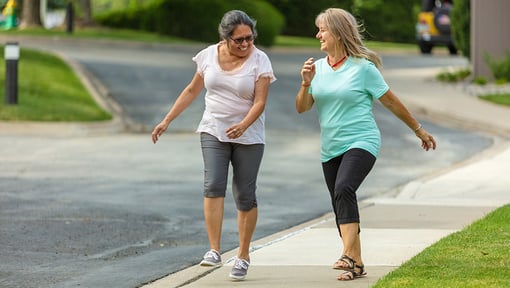
If you speed up and slow down during your walk, you’re doing intervals. You can do this in any number of ways, but the following 2 methods have been tested and proven to reap health benefits. These evidence-based routines can be done in about 30 minutes.
- Interval Walking Training (IWT), also known as Japanese Walking
- Work: 3 minutes
- Recover: 3 minutes
- Repeat 5 times
- The 5-2-4 Walking Workout
This workout gets its name from the intervals within it. Here’s how to do it:
- Work: 5 minutes
- Recover: 2 minutes
- Repeat 4 times
With either method, don’t forget to warm up and cool down. Try walking for 5 minutes at a low to moderate intensity at the beginning and end of your workout.

Tips for success
Start where you are. If you’re just beginning an exercise routine, keep your working phase at a moderate intensity. You can build up both your speed and intensity over time as you build strength and endurance.
If you don’t have the time or energy for a 30-minute walk just yet, start with less. That’s the best thing about interval walking—it can be tailored to fit your lifestyle and current fitness level. Make your working phase anywhere from 30 seconds to 2 minutes and your recovery phase 1 to 3 minutes. Repeat for a total of 10 to 30 minutes. Then try one of the methods above when you’re ready for more. For optimal health, strive for 150 minutes of moderate-intensity exercise each week.
Over time, you can adjust your routine. Add time, switch up your intervals, or add hills or stairs for variety. But always make sure you’re exercising safely. Wear comfortable, supportive shoes. Watch out for uneven ground and tripping hazards. And stay hydrated. If you have any health conditions, talk with your doctor before starting any new exercise routine.
Interval walking is not only a fun way to mix things up, but it's also a fantastic choice for boosting your health and well-being. And it’s a simple way to add intensity without the impact. Every step you take, fast and slow, is a step closer to a healthier you.
Ready for more walking inspiration? Learn how walking tours can help keep exercise even more interesting!

Not a Silver&Fit® member? Learn more about everything the program has to offer, including more helpful healthy living tips like this, here on our website.
This information is not intended to take the place of regular medical care or advice. Please check with your doctor before using this information or beginning any self-care program. Images used for this article do not depict any members of the Silver&Fit Program.
References
Cleveland Clinic. (2023, November 1). Rated perceived exertion (RPE) scale. https://my.clevelandclinic.org/health/articles/17450-rated-perceived-exertion-rpe-scale
Department of Health, State Governments of Victoria, Australia. (2024, May 7). Exercise intensity. Better Health Channel. https://www.betterhealth.vic.gov.au/health/healthyliving/exercise-intensity
Gagliardi, C. (2025, July 25). The 5-2-4 walking workout. American Council on Exercise. https://www.acefitness.org/resources/pros/expert-articles/8928/the-5-2-4-walking-workout/
Harvard Medical School. (2021, May 1). Step up your walking workouts. Harvard Health Publishing. https://www.health.harvard.edu/staying-healthy/step-up-your-walking-workouts
Henry Ford Health. (2025, August 7). The health benefits of interval walking. https://www.henryford.com/blog/2025/08/benefits-of-interval-walking
Karstoft, K., Thorsen, I.K., Nielsen, J.S., Solomon, T. P. J., Masuki, S., Nose, H., & Ried-Larsen, M. (2024). Health benefits of interval walking training. Applied Physiology, Nutrition, and Metabolism, 49(7), 1002–1007. https://doi.org/10.1139/apnm-2023-0595
Mayo Clinic. (2024, March 12). Walking: Trim your waistline, improve your health. https://www.mayoclinic.org/healthy-lifestyle/fitness/in-depth/walking/art-20046261
Mayo Clinic Health System. (2023, January 31). Interval training for heart health. https://www.mayoclinichealthsystem.org/hometown-health/speaking-of-health/interval-training-for-heart-health
Nemoto, K., Gen-no, H., Masuki, S., Okazaki, K., & Nose, H. (2007). Effects of high-intensity interval walking training on physical fitness and blood pressure in middle-aged and older people. Mayo Clinic Proceedings, 82(7), 803–811. https://doi.org/10.4065/82.7.803
Walrod, B. (2025, October 22). The benefits of interval walking training. The Ohio State University. https://health.osu.edu/wellness/exercise-and-nutrition/benefits-interval-walking-training
This article was written by Keleigh Somes, edited by Jason Nielsen, and clinically reviewed by Jaynie Bjornaraa, PhD, MPH, PT, LAT, ATC, CSPS, on January 9, 2026.