---
title: Pursue Lifelong Learning for Brain Fitness
description: Keep up your brain fitness with lifelong learning in a classroom or on your own. This can lead to new connections in your brain (neuroplasticity) and fend off dementia.
image: https://blog.silverandfit.com/hubfs/SF%20Blog/Article%20Images/Blog%20211%20-%20Brain%20Fitness/Healthy%20Aging_Feature_Lifelong%20learning.jpg
---
[LOG IN](https://www.silverandfit.com/identity/login) [Check Eligibility](https://www.silverandfit.com/identity/registration)
- [HOMEPAGE](https://www.silverandfit.com/)
- [WELL-BEING CLUB](https://www.silverandfit.com/well-being-club)
- [FITNESS CENTERS](https://www.silverandfit.com/search)
- FIT AT HOME
- [Workouts](https://www.silverandfit.com/workouts)
- [Home Kits](https://www.silverandfit.com/home-kits)
- [PARTICIPATING HEALTH PLANS](https://www.silverandfit.com/health-plans)
- [HOW IT WORKS](https://www.silverandfit.com/how-it-works)
- [FAQ](https://www.silverandfit.com/faq)
- [BLOG](https://blog.silverandfit.com/)
### Topics
- Select a Topic
- [All](https://blog.silverandfit.com)
- [Nutrition](https://blog.silverandfit.com/tag/nutrition)
- [Healthy Aging](https://blog.silverandfit.com/tag/healthy-aging)
- [Fitness](https://blog.silverandfit.com/tag/fitness)
- [Lifestyle](https://blog.silverandfit.com/tag/lifestyle)
### Get the latest tips in your inbox
SUBSCRIBE

By providing your email you consent to receiving updates to the Silver&Fit blog by email. Silver&Fit does not share or sell your email to any third-parties. You may unsubscribe at any time by clicking the link at the bottom of the email.
[Healthy Aging](https://blog.silverandfit.com/tag/healthy-aging)
# Pursue Lifelong Learning for Brain Fitness

By [The Silver&Fit® Team at American Specialty Health](https://blog.silverandfit.com/author/american-specialty-health) on June 15, 2026
[](http://www.facebook.com/sharer/sharer.php?u=https://blog.silverandfit.com/tag/healthy-aging/brain-fitness) [](https://twitter.com/home?status=Pursue%20Lifelong%20Learning%20for%20Brain%20Fitness+https://blog.silverandfit.com/tag/healthy-aging/brain-fitness) [](http://www.linkedin.com/shareArticle?mini=true&url=https://blog.silverandfit.com/tag/healthy-aging/brain-fitness) [](mailto:?body=https://blog.silverandfit.com/tag/healthy-aging/brain-fitness)

Keep up your brain fitness with lifelong learning in a classroom or on your own. This can lead to new connections in your brain (neuroplasticity) and fend off dementia.
Keeping your brain as healthy as possible is a top goal, right? And one way to keep your brain in good working condition, no matter your age, is to enjoy lifelong learning. Your formal schooldays may be over, but you never have to stop learning. Whether you’re mastering a new language, diving into digital skills, or exploring a lifelong interest, learning is a strong tool for maintaining brain fitness.
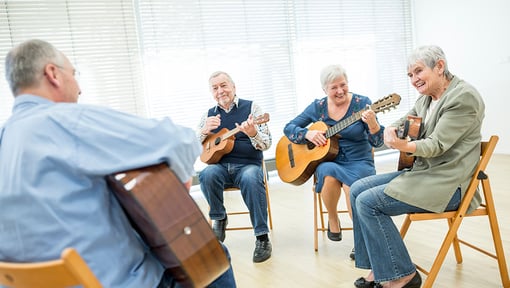
**How does lifelong learning physically boost brain health?**
Learning fills in gaps in your knowledge. It teaches you to judge and analyze information. It cultivates your sense of wonder. But much more is going on. Learning also affects your brain physically. It leads to the literal growth of your brain.
This is because learning something new affects the brain in ways that promote the growth of new neural pathways. In health care, the term for this is [neuroplasticity](https://blog.silverandfit.com/tag/lifestyle/neuroplasticity). When you take in information, new connections form between the billions of neurons in your brain. This rewiring allows your mind to grow.
Science has discovered this wonderful process of the brain only in the last few decades. It’s not a given that your brain will decline with age. You can take steps to prevent that. And as you protect your brain against decline, you are in a better position to avoid or delay dementia and Alzheimer’s disease.
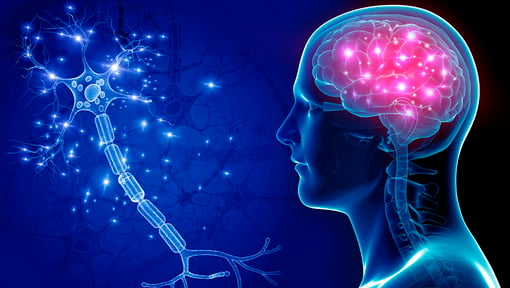
**Practical rewards of leaning into neuroplasticity**
On a practical, everyday level, learning can enhance your quality of life. Embracing learning at any age can foster confidence to tackle more learning. Once you see that you can learn something new, you may be more inclined to keep on learning. This may translate to practical needs such as understanding computer programs and keeping track of your schedule.
Here are a few other ways [brain fitness can help with everyday life](https://www.apa.org/monitor/2026/04-05/learning-protects-aging-brain) :
- You will be more likely to rise to new challenges and changes. You will be flexible when life changes come your way.
- You will likely be more independent as you age. If your brain fitness lets you handle routine tasks, such as keeping track of medicines and balancing your bank account, you will be able to live longer without outside help.
- Your memory will be sharper. Learning boosts brain health, and in turn, your memory.
Who wouldn’t want to take the best care of their brain? And learning is easy to consciously incorporate into your life to support brain health. You can find endless ways to enjoy lifelong learning. Read on for ideas to get you started.
**Ways to enjoy lifelong learning with academic courses**
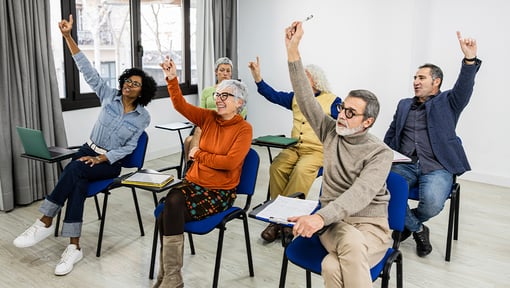
You may choose to go back to school, either in a classroom or online.
In-person classroom learning. Check local adult education programs, community programs such as those at the YMCA, community colleges, and local universities for interesting offerings.
If a weeks-long course is more than you want to tackle, look for seminars and workshops in your area. Sometimes a day-long course is a perfect way to enjoy learning.
Online learning. When it comes to online courses, location is no barrier. You can sign up for courses or degree programs in schools far from where you live. You may dip your toe in the water by taking one online learning course in something that interests you.
For example, you may want to travel to Ireland. So, take an online course in the history of Ireland or its geography, literature, or music. You may want to narrow your focus to the story of the Titanic’s construction in Belfast or the brewing of Guinness beer in Dublin. Sounds fun, doesn’t it?
One of the most common areas of online learning is languages. Have you always wanted to speak French? Take a free or low-cost online course and spend just minutes a day opening up a whole new world.
**Pursuing learning on your own**
Going beyond formal courses, you can delve into learning on your own. Here are a few ideas:
- Explore new hobbies. Anything that engages your mind can boost brain fitness. Commit time to exploring something new or following a passion that you never quite got around to pursuing. Delve into gardening and learn about plants that thrive in your area. Research your family tree. Learn how to set up a blog and start writing posts. Read books by an author you admire.
- Pick a topic to study. Whether it’s ancient history or today’s headlines, plenty of subjects call for analysis. Maybe a scientific or medical topic interests you. Choose one, then ask objective questions. Find many viewpoints on the topic. Make a timeline of how ideas have changed. Try to find primary sources such as diaries, military records, or journal articles. Think about how to test the credibility of sources.
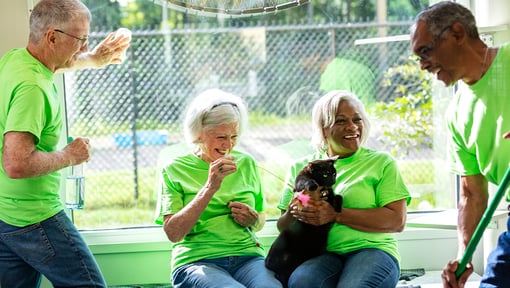
- **Volunteer.** When you volunteer, you not only grow your own skills, but you also help others. For example, volunteering at an animal shelter teaches you how to care for the animals. You may learn anything from how to feed a newborn kitten to how to walk a 90-pound dog on a leash. At the same time, you are working to make the animals adoptable. And this benefits potential adopters. If that’s not enough to inspire you, volunteering can also mean you are part of a group of other volunteers, and the [social aspect](https://www.spectrumcs.org/about/blog/383-the-benefits-of-lifelong-learning-for-seniors-brain-health-and-socialization) is good for brain health.
**No need to limit your learning experiences**
Variety is key to learning. Take part in a variety of educational activities to get the most benefit for brain health. If your time is limited, choose one way to pursue lifelong learning for a set period. You might sign up for a semester-long college course, for example. When that ends, spend time on your own studying a subject that interests you. Later, volunteer to help with a special event such as a marathon, adding a social aspect to your learning. Meanwhile, plan a trip to a place that interests you and research its history before you go. You will wake up each day looking forward to enrichment.
Engaging in learning activities can lead to a healthier, more fulfilling life. Research shows that lifelong learning is even more effective for brain health when you follow an interest you truly enjoy. Challenge yourself to keep learning, and you can be sure you are fostering brain fitness. And enjoying your life, too.

Not a Silver&Fit® member? Learn more about everything the program has to offer, including more helpful healthy living tips like this, [here on our website](https://www.silverandfit.com/).
*This information is not intended to take the place of regular medical care or advice. Please check with your doctor before using this information or beginning any self-care program. Images used for this article do not depict any members of the Silver&Fit Program.*
**References**
American Psychological Association. (2026, February 25). Learning protects the aging brain. [https://www.apa.org/monitor/2026/04-05/learning-protects-aging-brain](https://www.apa.org/monitor/2026/04-05/learning-protects-aging-brain)
Center for Brain Health. (n.d.). How does lifelong learning power your brain? [https://centerforbrainhealth.org/article/thrive-through-lifelong-learning](https://centerforbrainhealth.org/article/thrive-through-lifelong-learning)
Cleveland Clinic. (2023, December 13). Brain work: The power of neuroplasticity. [https://health.clevelandclinic.org/neuroplasticity](https://health.clevelandclinic.org/neuroplasticity)
Flexman R. (2021). Lifelong learning: A key weapon in Delaware's fight against cognitive decline. Delaware Journal of Public Health, 7(4), 124–127. [https://doi.org/10.32481/djph.2021.09.015](https://doi.org/10.32481/djph.2021.09.015)
Mayo Clinic. (2024, April 12). The power of neuroplasticity: How your brain adapts and grows as you age. [https://mcpress.mayoclinic.org/healthy-aging/the-power-of-neuroplasticity-how-your-brain-adapts-and-grows-as-you-age/](https://mcpress.mayoclinic.org/healthy-aging/the-power-of-neuroplasticity-how-your-brain-adapts-and-grows-as-you-age/)
Rauchman, B. (2023, March 28). Neuroplasticity and healthy aging: What you need to know. Pacific Neuroscience Institute. [https://www.pacificneuroscienceinstitute.org/blog/brain-health/neuroplasticity-and-healthy-aging-what-you-need-to-know/](https://www.pacificneuroscienceinstitute.org/blog/brain-health/neuroplasticity-and-healthy-aging-what-you-need-to-know/)
Stanford Social Innovation Review. (2021, April 12). Long-life learning and the age integration of higher education. [https://ssir.org/articles/entry/long\_life\_learning\_and\_the\_age\_integration\_of\_higher\_education](https://ssir.org/articles/entry/long_life_learning_and_the_age_integration_of_higher_education)
Spectrum Community Services. (2024, May 23). The benefits of lifelong learning for seniors: Brain health and socialization. [https://www.spectrumcs.org/about/blog/383-the-benefits-of-lifelong-learning-for-seniors-brain-health-and-socialization](https://www.spectrumcs.org/about/blog/383-the-benefits-of-lifelong-learning-for-seniors-brain-health-and-socialization)
This article was written by Sharon Odegaard, edited by Jason Nielsen, and clinically reviewed by Elizabeth Thompson, MPH, RDN, on March 27, 2026.
[Return to Homepage](https://blog.silverandfit.com/)
## About the Author

### The Silver&Fit® Team at American Specialty Health
The award-winning Silver&Fit® Blog is brought to life by a seasoned team of professionals at American Specialty Health (ASH), an organization with nearly 2 decades of experience in senior wellness programming. The Silver&Fit® blog writers, editors, clinicians, designers, and marketing specialists are dedicated to delivering engaging, informative wellness content. Every article is carefully researched and clinically reviewed for accuracy. Our goal? Content that supports healthy aging through trusted, research-based insights on fitness, nutrition, stress management, and more, tailored specifically for older adults seeking to live more vibrant, active, and healthy lives.
#### Recommended Articles
[](https://blog.silverandfit.com/tag/healthy-aging/green-spaces)
##### [Nature RX: How Green Spaces Protect Your Brain Health](https://blog.silverandfit.com/tag/healthy-aging/green-spaces)
\- September 14, 2026
[](https://blog.silverandfit.com/tag/healthy-aging/antibiotic-resistance)
##### [The Dangers of Antibiotic Resistance](https://blog.silverandfit.com/tag/healthy-aging/antibiotic-resistance)
\- August 17, 2026
[](https://blog.silverandfit.com/tag/healthy-aging/balance-training)
##### [6 Simple Balance Training Exercises to Help Prevent Falls](https://blog.silverandfit.com/tag/healthy-aging/balance-training)
\- June 29, 2026
### Popular Posts
### Get the latest tips from Silver&Fit in your inbox.
### Recent Post
### Recent Posts
[How to Eat More Leafy Greens—Even If You Don’t Love Kale](https://blog.silverandfit.com/tag/nutrition/leafy-greens)
\- 15 June, 2026
[How to Build Empathy for Stronger Bonds and Better Health](https://blog.silverandfit.com/tag/lifestyle/empathy)
\- 15 June, 2026
[Training for Pickleball: Strength, Balance, and Injury Prevention](https://blog.silverandfit.com/tag/fitness/pickleball-training)
\- 15 June, 2026
[Why Solitude Is as Important to Your Well-Being as Socializing](https://blog.silverandfit.com/tag/lifestyle/solitude)
\- 15 June, 2026
[Nature RX: How Green Spaces Protect Your Brain Health](https://blog.silverandfit.com/tag/healthy-aging/green-spaces)
\- 15 June, 2026
Brought To You By
### Silver&Fit
The Silver&Fit® program provides eligible members with a fitness center membership and options to stay Fit at Home.
-
-
-
-
-
### Topics
- [Nutrition (57)](https://blog.silverandfit.com/tag/nutrition)
- [Healthy Aging (55)](https://blog.silverandfit.com/tag/healthy-aging)
- [Fitness (53)](https://blog.silverandfit.com/tag/fitness)
- [Lifestyle (53)](https://blog.silverandfit.com/tag/lifestyle)
### We've been expertly designing senior fitness programs for nearly 20 years. Now, we're excited to share the health in our blog, free and available to the public. Interested? Get the latest fitness, healthy aging, lifestyle, and nutrition tips in your inbox!
SUBSCRIBE
[Facebookfacebook](https://www.facebook.com/SilverandFit) [Instagraminstagram](https://www.instagram.com/silverandfit/?hl=en) [youtube](https://www.youtube.com/user/silverandfit) [Pinterestpinterest](https://pinterest.com/silverandfit) [LinkedInlinkedin](https://www.linkedin.com/company/american-specialty-health)
- Useful Links
- [About Us](https://www.silverandfit.com/About)
- [Terms & Conditions](https://www.silverandfit.com/TermsAndConditions)
- [Privacy Statement](https://www.silverandfit.com/Privacy)
- [FAQ](https://www.silverandfit.com/FAQ)
- [Site Map](https://www.silverandfit.com/sitemap)
## Connect
[Contact Us](https://www.silverandfit.com/contactus)
## Language Assistance
The following PDF files will open in a new window. You must have [Adobe ReaderOpens an external site in a new tab](https://acrobat.adobe.com/us/en/acrobat/pdf-reader.html) installed to view the files.
- [English](https://blog.silverandfit.com/hubfs/SF%20Linked%20Files/M950-1031A%20Language%20Support_tcm26-161058.pdf)
- [Español](https://blog.silverandfit.com/hubfs/SF%20Linked%20Files/M950-1031A%20Language%20Support_tcm26-161058.pdf)
- [繁體中文](https://blog.silverandfit.com/hubfs/SF%20Linked%20Files/M950-1031A%20Language%20Support_tcm26-161058.pdf)
- [Tagalog](https://blog.silverandfit.com/hubfs/SF%20Linked%20Files/M950-1031A%20Language%20Support_tcm26-161058.pdf)
- [Tiếng Việt](https://blog.silverandfit.com/hubfs/SF%20Linked%20Files/M950-1031A%20Language%20Support_tcm26-161058.pdf)
- [العربية](https://blog.silverandfit.com/hubfs/SF%20Linked%20Files/M950-1031A%20Language%20Support_tcm26-161058.pdf)
- [Français](https://blog.silverandfit.com/hubfs/SF%20Linked%20Files/M950-1031A%20Language%20Support_tcm26-161058.pdf)
- [한국어](https://blog.silverandfit.com/hubfs/SF%20Linked%20Files/M950-1031A%20Language%20Support_tcm26-161058.pdf)
- [Русский](https://blog.silverandfit.com/hubfs/SF%20Linked%20Files/M950-1031A%20Language%20Support_tcm26-161058.pdf)
- [Deutsch](https://blog.silverandfit.com/hubfs/SF%20Linked%20Files/M950-1031A%20Language%20Support_tcm26-161058.pdf)
- [Kreyòl Ayisyen](https://blog.silverandfit.com/hubfs/SF%20Linked%20Files/M950-1031A%20Language%20Support_tcm26-161058.pdf)
- [हिंदी](https://blog.silverandfit.com/hubfs/SF%20Linked%20Files/M950-1031A%20Language%20Support_tcm26-161058.pdf)
- [Português](https://blog.silverandfit.com/hubfs/SF%20Linked%20Files/M950-1031A%20Language%20Support_tcm26-161058.pdf)
- [Italiano](https://blog.silverandfit.com/hubfs/SF%20Linked%20Files/M950-1031A%20Language%20Support_tcm26-161058.pdf)
- [Polski](https://blog.silverandfit.com/hubfs/SF%20Linked%20Files/M950-1031A%20Language%20Support_tcm26-161058.pdf)
- [اُردُو](https://blog.silverandfit.com/hubfs/SF%20Linked%20Files/M950-1031A%20Language%20Support_tcm26-161058.pdf)
- [אידיש](https://blog.silverandfit.com/hubfs/SF%20Linked%20Files/M950-1031A%20Language%20Support_tcm26-161058.pdf)
- [বাংলা](https://blog.silverandfit.com/hubfs/SF%20Linked%20Files/M950-1031A%20Language%20Support_tcm26-161058.pdf)
- [Ελληνικά](https://blog.silverandfit.com/hubfs/SF%20Linked%20Files/M950-1031A%20Language%20Support_tcm26-161058.pdf)
- [Shqiptar](https://blog.silverandfit.com/hubfs/SF%20Linked%20Files/M950-1031A%20Language%20Support_tcm26-161058.pdf)
Newtab\_Icon Clicking on these links will take you away from Silverandfit.com. Silver&Fit is not responsible for any content or the privacy practices of external websites.
The Silver&Fit program is a product of American Specialty Health Fitness, Inc. (ASH Fitness), a subsidiary of American Specialty Health Incorporated. ASH Fitness complies with applicable federal civil rights laws and does not discriminate on the basis of race, color, national origin, age, disability, or sex.
© 2020-2025 American Specialty Health Incorporated (ASH). All Rights Reserved.
Last Updated 11/2025