---
title: How to Keep Relationships Healthy As You Age
description: Relationship strains can arise over time. Learn ways to strengthen bonds, set healthy boundaries, and care for your well-being during times of stress, caregiving, and major life changes.
image: https://blog.silverandfit.com/hubfs/SF%20Blog/Article%20Images/Blog%20210%20-%20Healthy%20Relationships/Lifestyle_feature_Healthy-Relationships.png
---
[LOG IN](https://www.silverandfit.com/identity/login) [Check Eligibility](https://www.silverandfit.com/identity/registration)
- [HOMEPAGE](https://www.silverandfit.com/)
- [WELL-BEING CLUB](https://www.silverandfit.com/well-being-club)
- [FITNESS CENTERS](https://www.silverandfit.com/search)
- FIT AT HOME
- [Workouts](https://www.silverandfit.com/workouts)
- [Home Kits](https://www.silverandfit.com/home-kits)
- [PARTICIPATING HEALTH PLANS](https://www.silverandfit.com/health-plans)
- [HOW IT WORKS](https://www.silverandfit.com/how-it-works)
- [FAQ](https://www.silverandfit.com/faq)
- [BLOG](https://blog.silverandfit.com/)
### Topics
- Select a Topic
- [All](https://blog.silverandfit.com)
- [Nutrition](https://blog.silverandfit.com/tag/nutrition)
- [Healthy Aging](https://blog.silverandfit.com/tag/healthy-aging)
- [Fitness](https://blog.silverandfit.com/tag/fitness)
- [Lifestyle](https://blog.silverandfit.com/tag/lifestyle)
### Get the latest tips in your inbox
SUBSCRIBE

By providing your email you consent to receiving updates to the Silver&Fit blog by email. Silver&Fit does not share or sell your email to any third-parties. You may unsubscribe at any time by clicking the link at the bottom of the email.
[Lifestyle](https://blog.silverandfit.com/tag/lifestyle)
# How to Keep Relationships Healthy As You Age

By [The Silver&Fit® Team at American Specialty Health](https://blog.silverandfit.com/author/american-specialty-health) on June 8, 2026
[](http://www.facebook.com/sharer/sharer.php?u=https://blog.silverandfit.com/tag/lifestyle/healthy-relationships) [](https://twitter.com/home?status=How%20to%20Keep%20Relationships%20Healthy%20As%20You%20Age+https://blog.silverandfit.com/tag/lifestyle/healthy-relationships) [](http://www.linkedin.com/shareArticle?mini=true&url=https://blog.silverandfit.com/tag/lifestyle/healthy-relationships) [](mailto:?body=https://blog.silverandfit.com/tag/lifestyle/healthy-relationships)
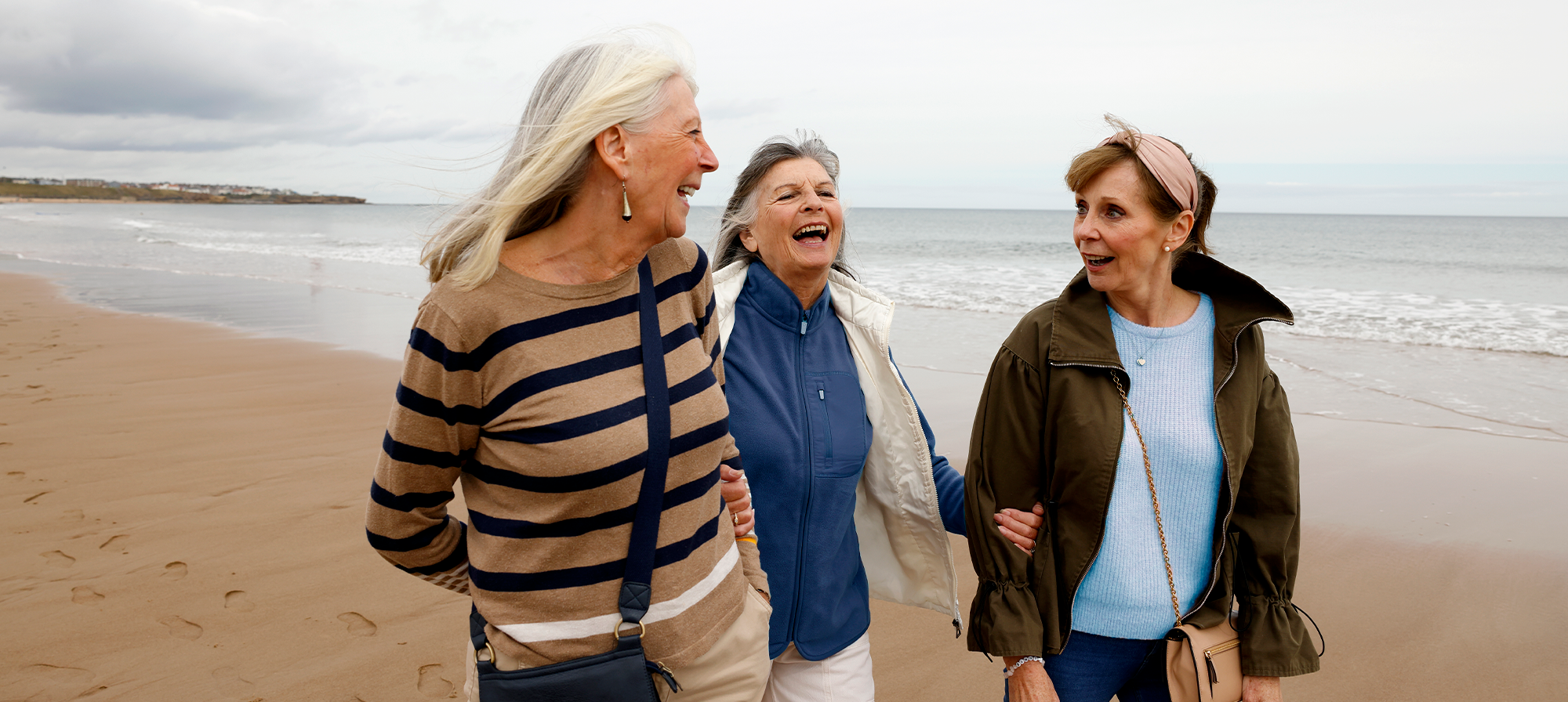
Relationship strains can arise over time. Learn ways to strengthen bonds, set healthy boundaries, and care for your well-being during times of stress, caregiving, and major life changes.
Over the course of your life, most relationships are bound to change. This holds true whether it’s a long-time friendship, a newly formed relationship, or a family bond. But if you start noticing these changes later in life, especially in your once-steady relationships, they might be the result of growing older.
**Why changes in your relationships can happen as you get older**
With age comes inevitable change. That’s just a fact of life. Your body changes, your everyday routine changes. You evolve, and so do your friends. These changes can also affect your relationships.
For example, maybe you [transition into retirement](https://blog.silverandfit.com/tag/lifestyle/retirement-routine). You have all this free time now, so you’re seeing more of your friends. With more time spent together, you start to notice incompatibility in certain friendships. Or maybe you’re facing new health issues and can no longer keep up with the active hobbies you used to do with your friends. As a result, you might start to feel left out.
You may even be transitioning into a caregiver role and trying to navigate that new reality. Or perhaps your adult children are taking on the role of your caretaker, which causes a shift in your dynamic. They’re now taking care of *you*.
Retirement, health changes, and caregiving are just a few factors that can affect your relationships. While changes in relationships are common, it’s still important to think about what these changes mean to you. Are they causing you to feel worse about yourself? Is the relationship no longer serving your well-being in a healthy way? If so, it might be time to set boundaries.

**The importance of setting boundaries**
Your relationships have a huge impact on your overall health and well-being. When relationship tensions arise, they can lead to feelings of stress and loneliness. This may result in [social isolation](https://blog.silverandfit.com/tag/healthy-aging/loneliness-isolation). All these factors together can raise the risk of depression, harm physical health, and contribute to cognitive decline.
This is why setting boundaries is so important. They help you recover after conflicts because you’re able to clarify what you’re comfortable with and communicate those limits. That way, the other person knows how not to overstep. Plus, it opens the door for them to set their own boundaries. This open communication is key to repairing a relationship that needs fixing.
**Start with the “green flags”**
No relationship is perfect, because no person is perfect. So, the goal isn’t perfection. Especially during challenging seasons. But you do always want to be sure that your relationship maintains certain “green flags”, also known as what defines a healthy relationship. [Research shows](https://www.mayoclinichealthsystem.org/hometown-health/speaking-of-health/maintaining-healthy-relationships-is-important-as-we-age) that key factors are respect, communication, trust, and clear boundaries.
So, you want to be sure these green flags are always present in your relationship—even if it feels rocky. Above all else, you want to feel safe to:
- Express needs
- Maintain individuality
- Resolve disagreements without insults or power struggles
Staying aligned with your identity and values helps keep others from taking advantage of you. And by expressing your needs in a healthy way, you respect both your own and others' needs. This puts you on the path to achieving a healthier, more respectful relationship.
So, what steps can you take to get there?

**How to set boundaries**
First things first, you need to get specific about your boundaries. This requires taking a moment to reflect on your personal needs and values. Consider what makes you feel comfortable and what leaves you feeling drained. Here are some types of boundaries to keep in mind:
- Physical, to protect your personal space
- Emotional, to protect your feelings and mental health
- Time-related, to protect how much time and energy you give others
For example, let’s say you’re dealing with a caregiving conflict. Your spouse or your adult child has taken over your finances. You start to notice yourself feeling more anxious about losing your independence and control of your finances. So, you set a boundary to feel more in control: “If you pay the bills, let’s review statements together every Friday.” This helps you feel more involved and less stressed.
Whatever your needs are, it’s helpful to pinpoint them clearly so you can ask for them to be met.
How you communicate your boundaries is also important. Try to [practice gratitude](https://blog.silverandfit.com/tag/lifestyle/gratitude) when you have this conversation. You still want to be direct. You still want to be intentional about what matters to you. But you also want to let the other know how much you value them in your life. By doing so, you can help foster feelings of compassion and empathy. This can help the conversation be more open and cooperative, which is key to creating a safe space for both of you.
Remember that it’s not about placing blame or calling out the other’s flaws. It’s about making your needs clear. It’s about maintaining emotional safety. It’s about returning to a place where you both feel your needs are being met. It’s about getting back to when things felt good, even if your lives look different now.
****
**Listen to your inner signals**
Notice how you continue to feel after your interactions. If you feel persistent dread or self-doubt, then you might want to reassess whether that relationship is worth trying to repair.
Safety always comes first. If you do not feel safe in your relationship, it’s crucial to [reach out for support](https://988lifeline.org/).
When you take steps to keep your relationships healthy, you help protect your mental health, autonomy, and quality of life. Setting clear, respectful boundaries helps you maintain open communication. And remember, your approach matters. Put your ego aside and be honest with yourself and others. You may even find that these efforts lead to less stress and greater well-being for everyone involved.
Not a Silver&Fit® member? Learn more about everything the program has to offer, including more helpful healthy living tips like this, [here on our website](https://www.silverandfit.com/).
*This information is not intended to take the place of regular medical care or advice. Please check with your doctor before using this information or beginning any self-care program. Images used for this article do not depict any members of the Silver&Fit Program.*
**References**
Centers for Disease Control and Prevention. (2026, January 28). Community connection and mental health. [https://www.cdc.gov/mental-health/about-data/community-connection.html](https://www.cdc.gov/mental-health/about-data/community-connection.html)
Cleveland Clinic. (2026, February 13). How to set healthy boundaries. Cleveland Clinic Health Essentials. [https://health.clevelandclinic.org/how-to-set-boundaries](https://health.clevelandclinic.org/how-to-set-boundaries)
Cleveland Clinic. (2023, June 6). 12 signs you’re in a healthy relationship. Cleveland Clinic Health Essentials. [https://health.clevelandclinic.org/signs-of-a-healthy-relationship](https://health.clevelandclinic.org/signs-of-a-healthy-relationship)
Mayo Clinic Health System Staff. (2025, May 15). Maintaining healthy relationships is important as we age. Mayo Clinic Health System. [https://www.mayoclinichealthsystem.org/hometown-health/speaking-of-health/maintaining-healthy-relationships-is-important-as-we-age](https://www.mayoclinichealthsystem.org/hometown-health/speaking-of-health/maintaining-healthy-relationships-is-important-as-we-age)
National Institutes of Health. (2018, April). Building social bonds: Connections that promote well-being. NIH News in Health. [https://newsinhealth.nih.gov/2018/04/building-social-bonds](https://newsinhealth.nih.gov/2018/04/building-social-bonds)
National Institutes of Health. (2025, March). Build social bonds to protect health. NIH News in Health. [https://newsinhealth.nih.gov/2025/03/build-social-bonds-protect-health](https://newsinhealth.nih.gov/2025/03/build-social-bonds-protect-health)
New York State Office for the Prevention of Domestic Violence. (n.d.). What does a healthy relationship look like? [https://www.ny.gov/teen-dating-violence-awareness-and-prevention/what-does-healthy-relationship-look](https://www.ny.gov/teen-dating-violence-awareness-and-prevention/what-does-healthy-relationship-look)
Pew Research Center. (2026, February 26). Family caregiving in an aging America. [https://www.pewresearch.org/social-trends/2026/02/26/family-caregiving-in-an-aging-america/](https://www.pewresearch.org/social-trends/2026/02/26/family-caregiving-in-an-aging-america/)
Substance Abuse and Mental Health Services Administration. (n.d.). 988 Suicide & Crisis Lifeline. [https://988lifeline.org/](https://988lifeline.org/)
U.S. Department of Health and Human Services, Office of the Surgeon General. (2023). Our epidemic of loneliness and isolation: The U.S. Surgeon General’s advisory on the healing effects of social connection and community. [https://www.hhs.gov/surgeongeneral/reports-and-publications/connection/index.html](https://www.hhs.gov/surgeongeneral/reports-and-publications/connection/index.html)
Youth.gov. (n.d.). Characteristics of healthy & unhealthy relationships. [https://youth.gov/youth-topics/teen-dating-violence/characteristics](https://youth.gov/youth-topics/teen-dating-violence/characteristics)
This article was written by Stephanie Ruiz, edited by Celina Johnson, and clinically reviewed by Elizabeth Thompson, MPH, RDN, on March 27, 2026.
[Return to Homepage](https://blog.silverandfit.com/)
## About the Author

### The Silver&Fit® Team at American Specialty Health
The award-winning Silver&Fit® Blog is brought to life by a seasoned team of professionals at American Specialty Health (ASH), an organization with nearly 2 decades of experience in senior wellness programming. The Silver&Fit® blog writers, editors, clinicians, designers, and marketing specialists are dedicated to delivering engaging, informative wellness content. Every article is carefully researched and clinically reviewed for accuracy. Our goal? Content that supports healthy aging through trusted, research-based insights on fitness, nutrition, stress management, and more, tailored specifically for older adults seeking to live more vibrant, active, and healthy lives.
#### Recommended Articles
[](https://blog.silverandfit.com/tag/lifestyle/solitude)
##### [Why Solitude Is as Important to Your Well-Being as Socializing](https://blog.silverandfit.com/tag/lifestyle/solitude)
\- September 21, 2026
[](https://blog.silverandfit.com/tag/lifestyle/gut-brain-connection)
##### [The Gut-Brain Connection and Its Impact on Your Health](https://blog.silverandfit.com/tag/lifestyle/gut-brain-connection)
\- August 31, 2026
### Popular Posts
### Get the latest tips from Silver&Fit in your inbox.
### Recent Post
### Recent Posts
[Training for Pickleball: Strength, Balance, and Injury Prevention](https://blog.silverandfit.com/tag/fitness/pickleball-training)
\- 8 June, 2026
[Why Solitude Is as Important to Your Well-Being as Socializing](https://blog.silverandfit.com/tag/lifestyle/solitude)
\- 8 June, 2026
[Nature RX: How Green Spaces Protect Your Brain Health](https://blog.silverandfit.com/tag/healthy-aging/green-spaces)
\- 8 June, 2026
[Fall Morning Muffins for a Cozy Start to Your Day](https://blog.silverandfit.com/tag/nutrition/fall-muffins)
\- 8 June, 2026
[The Gut-Brain Connection and Its Impact on Your Health](https://blog.silverandfit.com/tag/lifestyle/gut-brain-connection)
\- 8 June, 2026
Brought To You By

### Silver&Fit
The Silver&Fit® program provides eligible members with a fitness center membership and options to stay Fit at Home.
-
-
-
-
-
### Topics
- [Nutrition (57)](https://blog.silverandfit.com/tag/nutrition)
- [Healthy Aging (55)](https://blog.silverandfit.com/tag/healthy-aging)
- [Fitness (53)](https://blog.silverandfit.com/tag/fitness)
- [Lifestyle (52)](https://blog.silverandfit.com/tag/lifestyle)
### We've been expertly designing senior fitness programs for nearly 20 years. Now, we're excited to share the health in our blog, free and available to the public. Interested? Get the latest fitness, healthy aging, lifestyle, and nutrition tips in your inbox!
SUBSCRIBE
[Facebookfacebook](https://www.facebook.com/SilverandFit) [Instagraminstagram](https://www.instagram.com/silverandfit/?hl=en) [youtube](https://www.youtube.com/user/silverandfit) [Pinterestpinterest](https://pinterest.com/silverandfit) [LinkedInlinkedin](https://www.linkedin.com/company/american-specialty-health)
- Useful Links
- [About Us](https://www.silverandfit.com/About)
- [Terms & Conditions](https://www.silverandfit.com/TermsAndConditions)
- [Privacy Statement](https://www.silverandfit.com/Privacy)
- [FAQ](https://www.silverandfit.com/FAQ)
- [Site Map](https://www.silverandfit.com/sitemap)
## Connect
[Contact Us](https://www.silverandfit.com/contactus)
## Language Assistance
The following PDF files will open in a new window. You must have [Adobe ReaderOpens an external site in a new tab](https://acrobat.adobe.com/us/en/acrobat/pdf-reader.html) installed to view the files.
- [English](https://blog.silverandfit.com/hubfs/SF%20Linked%20Files/M950-1031A%20Language%20Support_tcm26-161058.pdf)
- [Español](https://blog.silverandfit.com/hubfs/SF%20Linked%20Files/M950-1031A%20Language%20Support_tcm26-161058.pdf)
- [繁體中文](https://blog.silverandfit.com/hubfs/SF%20Linked%20Files/M950-1031A%20Language%20Support_tcm26-161058.pdf)
- [Tagalog](https://blog.silverandfit.com/hubfs/SF%20Linked%20Files/M950-1031A%20Language%20Support_tcm26-161058.pdf)
- [Tiếng Việt](https://blog.silverandfit.com/hubfs/SF%20Linked%20Files/M950-1031A%20Language%20Support_tcm26-161058.pdf)
- [العربية](https://blog.silverandfit.com/hubfs/SF%20Linked%20Files/M950-1031A%20Language%20Support_tcm26-161058.pdf)
- [Français](https://blog.silverandfit.com/hubfs/SF%20Linked%20Files/M950-1031A%20Language%20Support_tcm26-161058.pdf)
- [한국어](https://blog.silverandfit.com/hubfs/SF%20Linked%20Files/M950-1031A%20Language%20Support_tcm26-161058.pdf)
- [Русский](https://blog.silverandfit.com/hubfs/SF%20Linked%20Files/M950-1031A%20Language%20Support_tcm26-161058.pdf)
- [Deutsch](https://blog.silverandfit.com/hubfs/SF%20Linked%20Files/M950-1031A%20Language%20Support_tcm26-161058.pdf)
- [Kreyòl Ayisyen](https://blog.silverandfit.com/hubfs/SF%20Linked%20Files/M950-1031A%20Language%20Support_tcm26-161058.pdf)
- [हिंदी](https://blog.silverandfit.com/hubfs/SF%20Linked%20Files/M950-1031A%20Language%20Support_tcm26-161058.pdf)
- [Português](https://blog.silverandfit.com/hubfs/SF%20Linked%20Files/M950-1031A%20Language%20Support_tcm26-161058.pdf)
- [Italiano](https://blog.silverandfit.com/hubfs/SF%20Linked%20Files/M950-1031A%20Language%20Support_tcm26-161058.pdf)
- [Polski](https://blog.silverandfit.com/hubfs/SF%20Linked%20Files/M950-1031A%20Language%20Support_tcm26-161058.pdf)
- [اُردُو](https://blog.silverandfit.com/hubfs/SF%20Linked%20Files/M950-1031A%20Language%20Support_tcm26-161058.pdf)
- [אידיש](https://blog.silverandfit.com/hubfs/SF%20Linked%20Files/M950-1031A%20Language%20Support_tcm26-161058.pdf)
- [বাংলা](https://blog.silverandfit.com/hubfs/SF%20Linked%20Files/M950-1031A%20Language%20Support_tcm26-161058.pdf)
- [Ελληνικά](https://blog.silverandfit.com/hubfs/SF%20Linked%20Files/M950-1031A%20Language%20Support_tcm26-161058.pdf)
- [Shqiptar](https://blog.silverandfit.com/hubfs/SF%20Linked%20Files/M950-1031A%20Language%20Support_tcm26-161058.pdf)
Newtab\_Icon Clicking on these links will take you away from Silverandfit.com. Silver&Fit is not responsible for any content or the privacy practices of external websites.
The Silver&Fit program is a product of American Specialty Health Fitness, Inc. (ASH Fitness), a subsidiary of American Specialty Health Incorporated. ASH Fitness complies with applicable federal civil rights laws and does not discriminate on the basis of race, color, national origin, age, disability, or sex.
© 2020-2025 American Specialty Health Incorporated (ASH). All Rights Reserved.
Last Updated 11/2025