Keep pickleball fun by taking steps to stay safe and injury-free. Try these simple exercises to build strength, improve balance, and support your game.
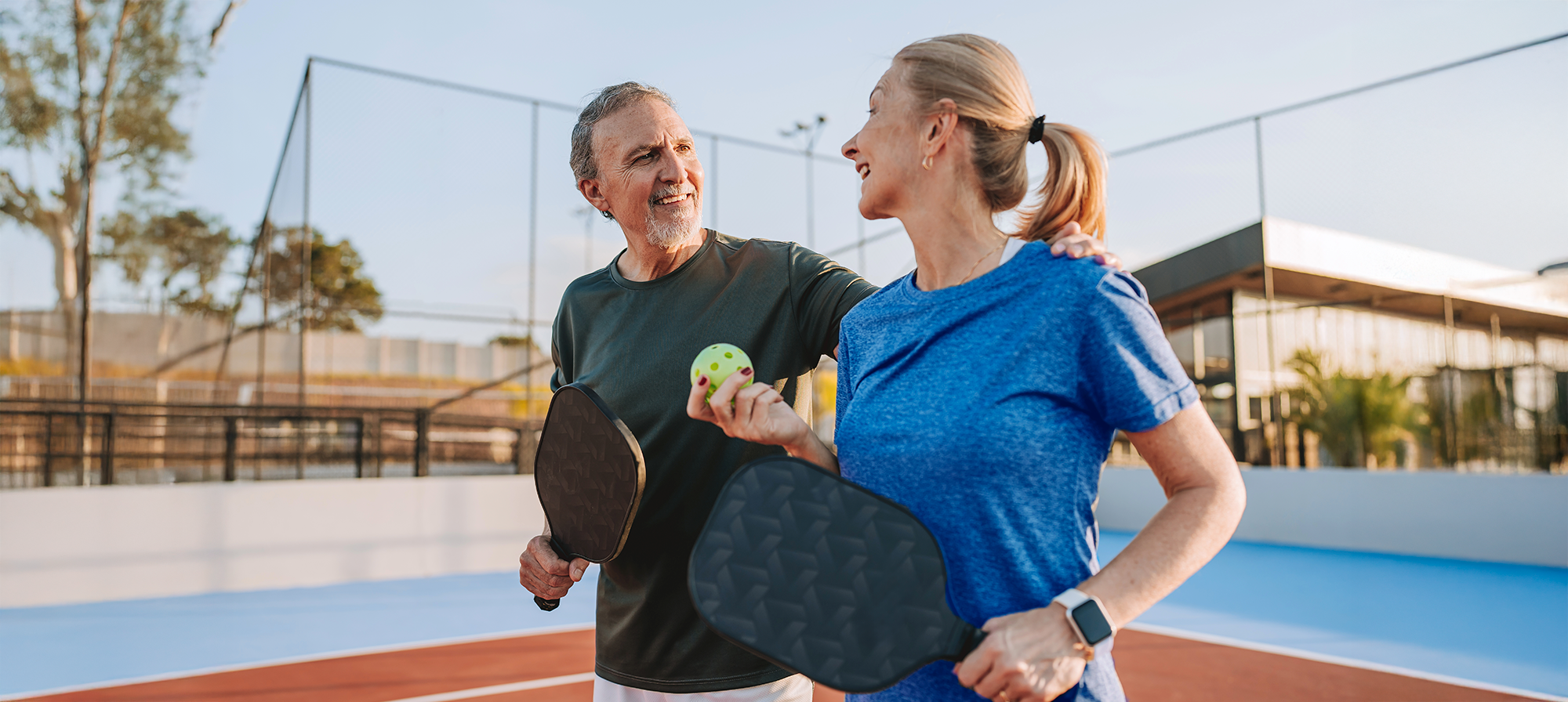
It seems like everyone is playing pickleball these days. And for good reason! The game is easy to learn, no matter your skill level. And it’s a fun way to get fit and agile. Plus, pickleball has a social side. Whether you’re teaming up with old friends or meeting new ones, pickleball is a great way to connect with others. And that social aspect, along with the exercise component, makes pickleball a natural mood booster.
Although pickleball is beginner-friendly, it can still be demanding. The quick stops, pivots, lunges, and balance needed for the sport all challenge your joints and muscles. Strains, overuse injuries, and fractures from falling on the court are possible. And as more people take up the sport, more pickleball injuries are happening.
But don’t let that stop you from playing! A little preparation and training goes a long way toward preventing injuries.
 How fit do you need to be to play pickleball?
Pickleball is for everyone, no matter how fit or athletic you are. You will find players of all ages, skills, and fitness levels on the pickleball court.
If you’re new to the game, start with relaxed matches. Play with other beginners or with seasoned players who will take it easy. Think about playing doubles, too, so you don’t have to cover the whole court. Doubles is commonly played at drop-in sessions and other more formal pickleball events. (Singles is a much more rigorous workout.)
As you play more, your game and your fitness will improve. But you can speed up your progress—and help prevent injuries—with targeted exercises for pickleball. Improving your balance and strengthening your legs, core, and shoulders can make the game safer and more enjoyable for you.
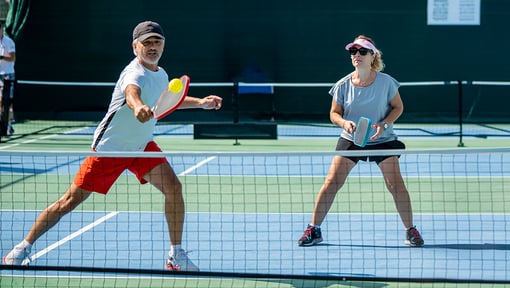
Your pickleball workout: Legs, shoulders, core, and balance
Your legs, shoulders, and core do the heavy lifting on the pickleball court. By building up the strength of these muscles, you can keep yourself safer when you play. And boosting your balance can help prevent falls that may lead to broken bones.
Legs
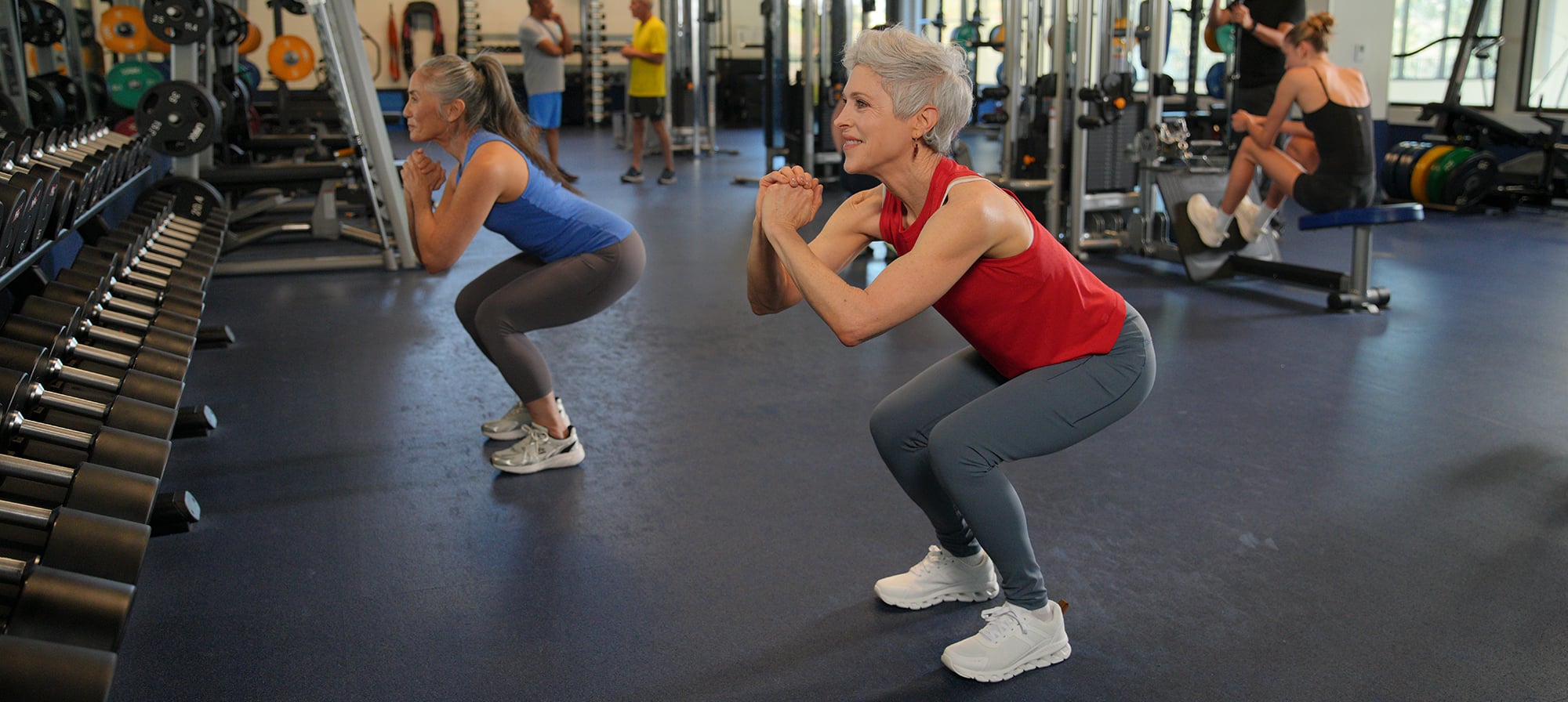
These leg exercises build strength, which helps you move faster on the court. They also help strengthen and stabilize your ankles and knees, reducing your risk of injury. Do these exercises near a wall, counter, or sturdy chair that you can hold on to for balance, as needed.
-
-
Stand with your feet about shoulder-width apart.
-
Keep your core tight as you push your hips back and bend your knees, as if you’re sitting down in a chair. Make sure your knees line up with your feet for the entire movement.
-
Push through your heels as you stand back up.
-
Perform 3 sets of 10-15 reps.
-
-
-
Stand with your feet about hip-width apart.
-
Step forward with your right foot. Bend your knees until your front leg is bent about 90 degrees and your back knee is almost touching the ground. Keep your torso upright.
-
Push up through your right heel to return to the starting position.
-
Repeat with left leg.
-
Perform 3 sets of 10-15 reps for each leg.
-
-
-
Stand with feet about hip-width apart, toes forward.
-
Slowly raise your heels as high as you can.
-
Lower heels back down slowly. Use support if needed.
-
Perform 3 sets of 10-15 reps.
-
Shoulders
Shoulder injuries from overuse are common in pickleball due to repeated swinging movements. Strengthening your shoulders can help prevent this type of injury. Plus, strong shoulders give you better control over the paddle.
-
-
Stand facing a wall with your feet about hip-width apart. Place your hands on the wall at shoulder height.
-
Keep your body in a straight line from your head to your heels as you bend your elbows and slowly lower your chest toward the wall.
-
Push through your hands to return to the starting position. To make it easier, stand closer to the wall. To make it harder, step your feet farther back.
-
Perform 3 sets of 10-15 reps.
-
If you’re ready for a greater challenge, try push-ups on a countertop instead of a wall. Or do modified push-ups on the ground, resting on your knees instead of your toes.
-
-
External rotation with resistance band
-
Attach a light resistance band to a secure surface at about waist height or hold one end of the band in your left hand.
-
Stand tall with your right elbow bent 90 degrees, keeping your upper arm against your side with a small, rolled towel in between. Your palm should be facing your left side, and you should feel some tension in the resistance band.
-
Roll up a small towel, place it between your side body and upper arm, and slowly rotate your forearm away from your body. Reduce the resistance if you feel pain.
-
Slowly return to the starting position. Repeat on the other side. Perform 3 sets of 10-15 reps on each side.
-
-
Wall ball roll
-
Stand facing a wall and place a small, soft ball between your left hand and the wall at about shoulder height.
-
Keep your shoulder relaxed and your elbow slightly bent. Gently press into the ball so it stays in place.
-
Slowly roll the ball in small circles. Keep the movement controlled and comfortable.
-
Switch directions, then repeat with the other arm. Perform 3 sets of 10-15 reps on each arm.
-
-
-
Sit or stand tall with a resistance band secured in front of you at about chest height.
-
Hold one end of the band in each hand with your arms straight in front of you and your palms facing each other.
-
Pull your elbows back toward your sides, squeezing your shoulder blades gently together. Keep your shoulders down and away from your ears.
-
Slowly release your arms back to the starting position. Perform 3 sets of 10-15 reps.
-
Core
A strong core supports your whole body. It helps you stay steady as you reach, twist, stop, and change direction on the pickleball court. It also improves your control and power when you hit the ball and helps you stay centered during sudden movements.
-
-
Lie on your back with your knees bent and your feet flat on the floor, about hip-width apart.
-
Keep your spine neutral and engage your core. Lift your hips, creating a straight line from your knees to your shoulders.
-
Slowly lower your hips back to the floor. Perform 3 sets of 10-15 reps.
-
-
-
Start on your hands and knees, with hands directly below your shoulders. (If this is hard on your wrists, you can lower onto your elbows, keeping your elbows in line with your shoulders.)
-
Step your feet back, one at a time, until your body forms a straight line from your head to your heels.
-
Tighten your core and keep your shoulders down, away from your ears.
-
Hold for 20 to 60 seconds while breathing normally, then rest. Perform 3 sets.
-
You can also perform a modified plank on your knees instead.
-
-
-
Start on your hands and knees, with your hands under your shoulders and your knees under your hips. If needed, place a folded towel under your knees for comfort.
-
Tighten your core and keep your back flat, like a tabletop.
-
Slowly reach one arm forward and the opposite leg back. Keep your hips level and avoid arching your back. Only lift as high as your trunk.
-
Pause briefly, then return to the starting position. Repeat on the other side. To make it easier, lift only your arm or only your leg at first. Perform 3 sets of 10 reps per side.
-
Balance
Better balance is vital to lower your fall risk, but it’ll also help you feel more confident on the court. Include balance and agility exercises in your training. Think of agility as “balance in motion.” These are the skills that will help you start, stop, and change directions smoothly.
-
-
Stand near a counter or sturdy chair for support. Place your feet hip-width apart.
-
Lift one foot off the ground. You can hold your arms out to the sides to help with balance. Try closing your eyes.
-
Hold as long as you can, up to one minute. Then switch and balance on the other leg. Perform 3 sets of 10 reps per side.
-
-
-
Stand with your feet a little wider than hip width. Bend your knees and hips slightly, as if in a shallow squat.
-
Starting on your left foot, take 10 quick steps to the left. Stop and switch sides, taking 10 quick steps to your right. Repeat 2 more times.
-
Do you want more balance exercises? Check out these 4 balance exercises you can do at home
This pickleball workout targets the muscles you need to play your best game. Getting stronger, better balanced, and more agile will keep you safer on the pickleball court. But it's important to take steps to support your overall fitness, too. Don’t skip these fitness basics
Include strength training in your workout routine at least 2 days a week. Use the exercises above, but hit all other major muscle groups, too. Work out your hips, back, chest, and arms, as well as your legs, shoulders, and core.
Be sure to add aerobic exercise, too. This will boost your overall fitness and health, further improving your game. The general guideline is to get at least 150 minutes of aerobic exercise each week. That could include brisk walking or cycling on a stationary bike for 30 minutes a day, 5 days a week. (Don’t forget: Your pickleball games also count toward your weekly aerobic exercise goal.)
Other key tips to get the most out of your workout or game and keep yourself safe include:
-
Warm up before each workout or pickleball match. Take 5 to 10 minutes to get your body ready for the activity. Do some squats, lunges, arm circles, and other dynamic stretches. This helps loosen up your joints and get your blood flowing.
-
Cool down after each workout or pickleball match. Bring your heart rate down slowly with low-intensity activity, such as walking or slow-paced movements. Then do some static stretching. Focus on the major muscle groups you worked during your session. This will help your muscles recover and lessen soreness.
-
Wear good shoes. You may need different types of shoes for different activities. Running or walking shoes are designed for forward and backward movement. But on the pickleball court, there’s more side-to-side movement. Court shoes are designed for this and help protect your ankles. Plus, they’re made for quick starts and stops. Learn more about finding the right athletic shoe.
-
Stay hydrated. Drink water before, during, and after exercise.
-
Take rest days. Rest is just as important as training. No matter your fitness level, you need rest days to let your muscles recover and rebuild. Rest days can include low-impact activities like walking or yoga. This is called active recovery . If you’re new to pickleball or getting back into exercise, plan for more rest days. They’re key to building strength and help you avoid overtraining.
-
Listen to your body. Pay attention to any signs of pain or discomfort. If something feels off, take a break—don’t push through the pain. You may need to adjust your activity or even see a doctor. Knowing your body's limits can help you avoid injuries and support your long-term fitness journey.
By practicing these fitness basics, you can lower your risk of injury. Plus, you’ll get more out of your workout and play a better pickleball game.
When to pause and when to see a doctor
Mild muscle soreness is normal, especially when starting something new. This is called delayed onset muscle soreness (DOMS) and typically sets in 1 or 2 days after your workout. If you have DOMS after playing pickleball, you can repeat the same pickleball motions less intensely and that can help you recover. You can manage the pain with gentle massage, light exercise (like walking), and over-the-counter pain relievers, as needed. But avoid intense exercise, as it can make soreness worse or lead to injury.
If the pain doesn’t get better within a week, talk with your doctor. If you have any sharp pain, swelling, or trouble bearing weight, see your doctor right away. These are signs of injury that may need medical attention.
Get your game on
Pickleball is a great way to stay active, connect with others, and have fun. And with a little preparation, you can get your body ready for all those dinks, drives, and volleys. Start with a few simple strength and balance exercises, build up slowly, and listen to your body along the way. The goal isn’t to play harder—it’s to play smarter, feel more confident, and enjoy the game for years to come.
Not a Silver&Fit® member? Learn more about everything the program has to offer, including more helpful healthy living tips like this, here on our website.
This information is not intended to take the place of regular medical care or advice. Please check with your doctor before using this information or beginning any self-care program. Images used for this article do not depict any members of the Silver&Fit program.
References
American Orthopaedic Foot & Ankle Society. (2024, May 30). 6 tips to prevent pickleball injuries to your feet & ankles [Press release].
Centers for Disease Control and Prevention. (2023, December 20). Adult activity: An overview. https://www.cdc.gov/physical-activity-basics/guidelines/adults.html
Cleveland Clinic. (2025, September 26). How to make the most out of active recovery. https://health.clevelandclinic.org/active-recovery
Cleveland Clinic. (2025, December 19). Delayed onset muscle soreness (DOMS). https://my.clevelandclinic.org/health/diseases/delayed-onset-muscle-soreness
Christensen, L. (2025, October 28). Are lunges safe for older adults? Harvard Health Publishing. https://www.health.harvard.edu/bones-and-joints/are-lunges-safe-for-older-adults
Corliss, J. (2025, March 1). Practical pointers for pickleballers. Harvard Health Publishing. https://www.health.harvard.edu/heart-health/practical-pointers-for-pickleballers
Crouch, M. (2025, November 19). The #1 exercise to do as you get older. AARP.
https:/www.aarp.org/health/healthy-living/squats-best-exercise-for-strength/
Hartford Hospital. (2025, October 24). The 6 best exercises for your rotator cuff. https://hartfordhospital.org/about-hh/news-center/news-detail?articleId=67070
Harvard Medical School. (2021, April 1). The best core exercises for older adults. Harvard Health Publishing. https://www.health.harvard.edu/healthy-aging-and-longevity/the-best-core-exercises-for-older-adults
Hergott, C. & Rohrer, B. (2024, August 26). Staying strong and injury-free on the pickleball court. National Council on Aging. https://www.ncoa.org/article/staying-strong-and-injury-free-on-the-pickleball-court/
Hospital for Special Surgery. (2022, November 15). Stretches and exercises to prevent pickleball injuries. https://www.hss.edu/health-library/move-better/stretches-exercises-prevent-pickleball-injuries
Massachusetts General Hospital. (n.d.). Theraband strengthening exercises. https://www.massgeneral.org/assets/MGH/pdf/orthopaedics/sports-medicine/physical-therapy/mass-general-theraband-strengthening-for-the-shoulder.pdf
Sharp, M. R. (2024, August 13). Pickleball injuries are on this rise. Here are 10 tips to avoid them while playing. UCDavis Health. https://health.ucdavis.edu/news/headlines/pickleball-injuries-are-on-this-rise-here-are-tips-to-avoid-them-while-playing/2024/08
Stanten, M. (2023, June 30). Want to get in on the pickleball craze?
These tips can help you safely enjoy this popular sport. Consumer Reports. https://www.consumerreports.org/health/exercise-fitness/want-to-get-in-on-the-pickleball-craze-a4561348829/
Tobin, J., Abbasi, T., Nguyen, J., Dunn, P., Cashin, I., & Chung, M. (2025). Rising orthopedic injuries in pickleball: Insights from a 10-year national study. Journal of the American Osteopathic Academy of Orthopedics, 4(1). https://doi.org/10.70709/ec1mfy8wep
Touhey, D. C., Bozorgmehr, C. K., Tartibi, D. S., Smith, M. V., & Knapik, D. M. (2024). Pickleball injuries in the aging athlete: A critical analysis review. Cureus, 16(9), Article e69950. https://doi.org/10.7759/cureus.69950
This article was written by Keleigh Somes, edited by Jason Nielsen, and clinically reviewed by Jaynie Bjornaraa, PhD, MPH, PT, LAT, ATC, CSCS, CSPS, on July 5, 2026.